
Investing in a Marine Travel Lift – also known as a mobile boat hoist – is often the single most significant capital expenditure for a marina, shipyard, or port authority. It is the literal “spine” of the operation. When the hoist is moving, the business is making money; when it is idle or, worse, broken down, the entire facility grinds to a halt.
Because this is a multi-decade investment, the “off-the-shelf” approach rarely works. You aren’t just buying a piece of steel and some hydraulics; you are buying a long-term operational partner. To avoid the common pitfalls of procurement, here are the 10 critical questions you must ask your manufacturer before making your final decision.
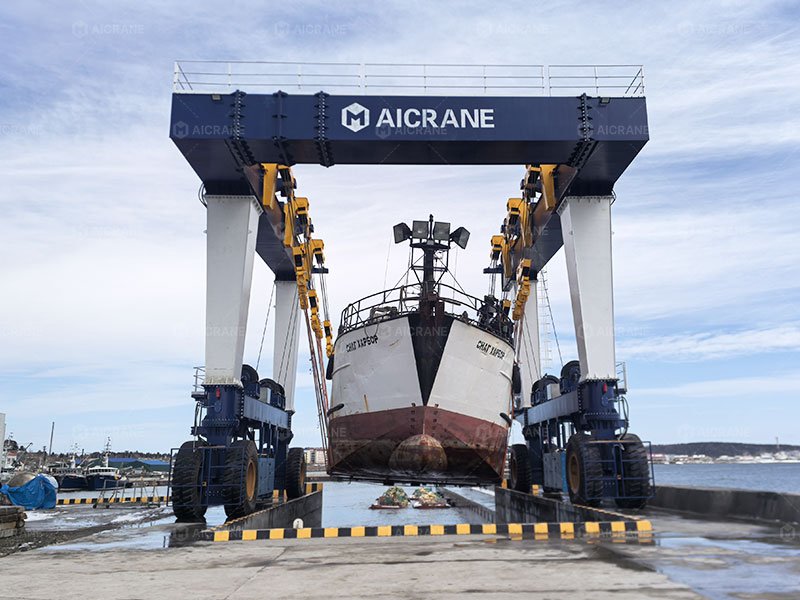
1. What is the Actual Lifting Capacity vs. the Effective Capacity?
It is a common mistake to assume a 100-ton marine travel lift can safely handle every 100-ton boat. In engineering terms, there is a major difference between a machine’s theoretical maximum and its daily operational comfort zone.
-
Weight Distribution: Boats are rarely perfectly balanced. Does the hoist handle uneven loads where 60% of the weight might be on the rear slings?
-
The “Dirty Weight”: When a boat comes out of the water, it often carries extra weight in the form of full fuel tanks, water ballasts, and heavy marine growth on the hull.
-
The Strategy: Always ask for the “Safe Working Load” (SWL) and ensure you have at least a 15% to 20% buffer. If your target market is 80-ton yachts, buying a 100-ton hoist ensures you aren’t constantly redlining your equipment.
2. Does the Width and Height Accommodate Modern Hull Designs?
The maritime industry has seen a massive surge in the popularity of wide-beam vessels, particularly power catamarans and sailing multihulls. If your hoist is too narrow, you are effectively turning away a high-revenue segment of the market.
-
Inside Clear Width: Measure the widest beam you expect to haul and add a clearance margin for slings and safety.
-
Pier Compatibility: This is the most expensive mistake to fix. Ensure the hoist’s tire track aligns perfectly with your existing concrete piers. If the hoist is too wide for your runways, the civil engineering costs to widen the piers will often exceed the cost of the hoist itself.
3. What Steering Modes are Included for Yard Efficiency?
A shipyard is essentially a high-stakes game of Tetris. The more boats you can fit into a square meter of land, the higher your ROI. The steering capabilities of your mobile boat hoist dictate how tightly you can pack those vessels.
-
Standard Steering: Usually front-wheel or rear-wheel only.
-
Advanced Steering: Ask about Carousel Steering (the ability to rotate 360° on its own axis) and Transverse Steering (moving sideways at a 90° angle).
-
Why it matters: Sideways movement allows you to tuck boats into tight corners that would be impossible to reach with standard steering, potentially increasing your yard’s storage capacity by 15-25%.
4. How Does the Machine Combat the “Saltwater Enemy”?
A marine travel lift lives its entire life in a high-corrosion zone. Salt spray, humidity, and UV rays are relentless. If the machine isn’t built for it, it will look a decade old within its first 24 months.
-
Surface Treatment: Is the frame hot-dip galvanized or protected by a high-zinc marine epoxy paint system?
-
Hardware Quality: Are the hydraulic fittings, nuts, bolts, and electrical cabinets made of corrosion-resistant materials like stainless steel or specialized alloys?
- Electrical Integrity: Ask for the IP (Ingress Protection) rating of the control boxes. In a marine environment, IP66 or higher is generally the requirement for longevity.
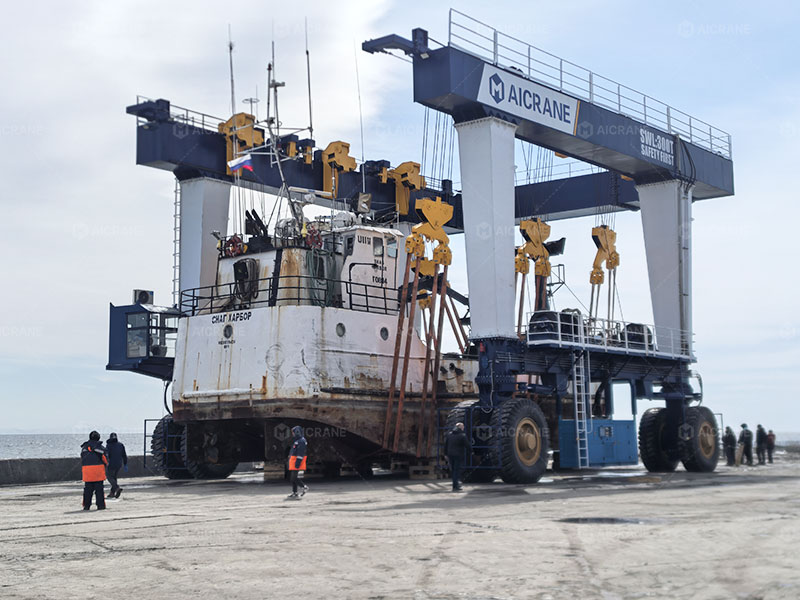
5. What is the Power Source Strategy: Diesel, Electric, or Hybrid?
The industry is moving away from traditional high-emission diesel engines toward cleaner, quieter solutions. Your choice here affects your operating costs and your relationship with the local community.
-
Full Electric (E-MTL): These offer zero emissions and near-silent operation. They are ideal for marinas located near residential areas or luxury resorts where noise pollution is a concern.
-
Maintenance Savings: Electric motors have far fewer moving parts than diesel engines – no oil filters, no cooling systems to flush, and no fuel injectors to fail.
-
The ROI: While the upfront cost of an electric or hybrid hoist is higher, the “Total Cost of Ownership” (TCO) is often lower due to reduced energy costs and maintenance intervals.
🚩 Red Flag Warning
If a manufacturer cannot provide a detailed “Recommended Spare Parts List” with local lead times, be wary. In the marine industry, “waiting for a part from overseas” is a euphemism for “losing thousands of dollars a day in haul-out fees.”
6. How Precise are the Sling Adjustment Capabilities?
Every boat has different “sling points”—the specific structural areas where the hull can be safely supported without crushing the shaft, the rudders, or the delicate fiberglass.
-
Power Adjustment: Can the operator move the slings forward and aft via remote control while the boat is in the air?
-
Independent Hoisting: Can the front and rear hoists be operated independently to level a boat that is bow-heavy or stern-heavy?
-
Hull Protection: Ask about the quality of the sling material and whether the hoist includes specialized “keel pads” or “hull protectors” to prevent scratching expensive anti-fouling paint or gelcoats.
7. What Safety and Telematics Features are Integrated?
Safety is the highest priority when suspending a multi-million dollar yacht over a concrete yard. Modern boat gantry cranes should offer more than just a manual “stop” button.
-
Load Readouts: Does the operator have a real-time digital display showing the exact weight on each sling? This prevents accidental overloading.
-
Remote Diagnostics: Can the manufacturer’s engineers log into your machine’s computer via the cloud? If an error code pops up, remote troubleshooting can often fix the issue in minutes, rather than waiting for a technician to travel to your site.
-
Operator Control: Is the radio remote control ergonomic and equipped with a “dead-man’s switch” for emergency stops?
8. What is the Maintenance Access and Schedule?
If a machine is hard to maintain, it won’t be maintained. It’s that simple.
-
Ground-Level Access: Can filters, fluids, and grease points be reached from the ground, or does a technician need a cherry picker just to check the oil?
-
Automatic Lubrication: Ask if the hoist features an automatic greasing system. For machines with dozens of pivot points, an auto-lubricator ensures the machine stays healthy even during the busiest “haul-out season” when manual maintenance might be skipped.
9. Is the Manufacturer’s Support Truly Global (or Local)?
The purchase price of the hoist is only about 40% of the lifetime cost. The rest is service.
-
Training: Does the purchase include on-site training for your operators and maintenance staff?
-
Part Interoperability: Does the hoist use “closed-loop” proprietary parts that you can only buy from the manufacturer, or does it use world-class components (like Bosch Rexroth hydraulics or Cummins engines) that can be serviced by local experts? Using globally recognized components is a massive advantage for uptime.
10. What is the Historical Resale Value of the Brand?
Eventually, you will want to upgrade. A high-quality marine travel lift should be treated as a liquid asset.
-
The “Used” Market: Some brands lose 50% of their value the moment they hit the pier. Others, known for their structural integrity and long life, can retain 70-80% of their value even after 10 years of service.
-
Documentation: Ensure the boat gantry crane manufacturer provides a full “as-built” documentation package, including hydraulic schematics and wiring diagrams. This documentation is essential when you eventually decide to sell the machine on the secondary market.
Comparison: Standard vs. Premium Mobile Boat Hoists
| Feature | Standard “Budget” Hoist | High-Performance Premium Hoist |
| Steering | 2-Wheel Only | Multi-mode (Carousel, Sideways, All-Wheel) |
| Corrosion Protection | Standard Industrial Paint | Hot-Dip Galvanized / Marine Epoxy |
| Sling Control | Fixed or Manual Slide | Hydraulic Power-Adjustable |
| Diagnostics | Local Error Codes Only | Cloud-Based Remote Telematics |
| Resale Value | Low / Variable | High / Predictable |
Conclusion: Investing in Reliability
Choosing a mobile boat hoist is a decision that will echo through your shipyard’s balance sheet for the next 20 to 30 years. While it is tempting to focus solely on the initial purchase price, the most successful marina operators look at reliability, yard density, and ease of service.
By asking these 10 questions, you move beyond the brochure and start understanding the operational reality of the machine. Remember: a hoist that saves you $50,000 upfront but costs you three weeks of downtime during peak season is the most expensive machine you will ever own. Focus on the partnership, the engineering, and the long-term support, and your “Big Lift” will be the best investment your business ever makes.