
A 50 ton gantry crane is not defined by lifting capacity alone. Two cranes may both be rated for 50 tons but have very different structural designs, hoisting mechanisms, motor configurations, and service lives because they are designed for different operating conditions.
One of the most important factors in this regard is the duty class. For industrial cranes designed according to FEM classifications, A5, A6, and A7 represent progressively more demanding operating conditions. The correct classification depends on how often the crane lifts loads, how long it operates, and what proportion of its rated capacity it handles.
For a 50 ton gantry crane, selecting the appropriate duty class is particularly important because the crane is handling substantial loads. A crane designed for occasional heavy lifting should not automatically be treated as equivalent to one operating continuously in a busy production yard.
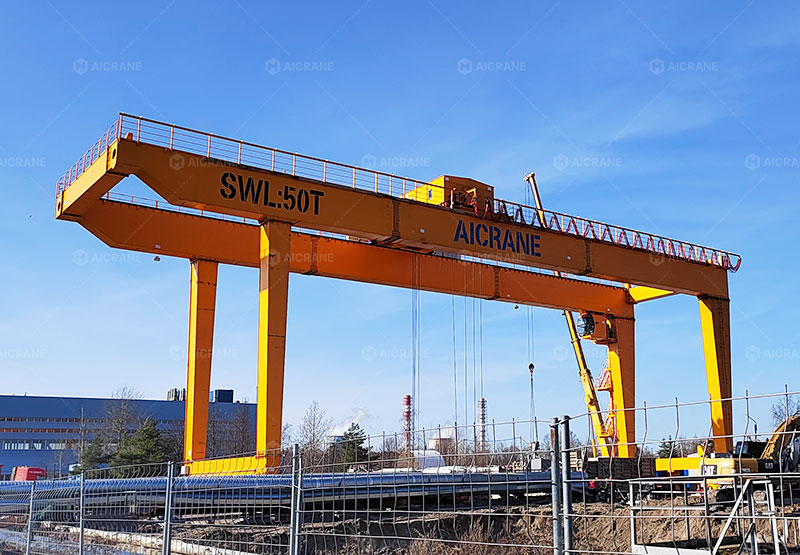
What Does Duty Class Mean for a 50 Ton Gantry Crane?
Duty class describes the expected working conditions and load spectrum of a crane rather than simply its maximum lifting capacity.
For a 50 ton gantry crane, the classification considers factors such as:
- Number of lifting cycles
- Average operating time
- Load spectrum
- Frequency of rated-load lifting
- Hoisting, trolley and crane travel movements
- Required service life
- Working environment
- Production schedule
A crane used for several heavy lifts per day may have completely different design requirements from a crane operating throughout multiple shifts.
This is why saying that a crane is “50 ton” does not provide enough information to determine whether it is suitable for a particular application. Capacity tells you how much the crane can lift; duty class indicates how frequently and intensively it is expected to perform that work.
A5 vs. A6 vs. A7: What Is the Difference?
A5, A6, and A7 are commonly used FEM duty classifications for industrial gantry crane applications.
In general:
A5: Medium-duty operation
A6: Heavy-duty operation
A7: Very heavy or intensive-duty operation
The actual design classification should be determined from the project’s operating cycle and load spectrum rather than selected simply because a higher class sounds better.
A simplified comparison is:
| Duty Class | Typical Operating Pattern | Typical Application |
|---|---|---|
| A5 | Moderate use | General industrial yards, workshops, fabrication |
| A6 | Frequent and heavier use | Production facilities, steel handling, precast yards |
| A7 | Intensive and repetitive use | Heavy manufacturing, continuous production, demanding material handling |
These descriptions are general. The final classification should be calculated according to the applicable crane design standard and the actual operating conditions.
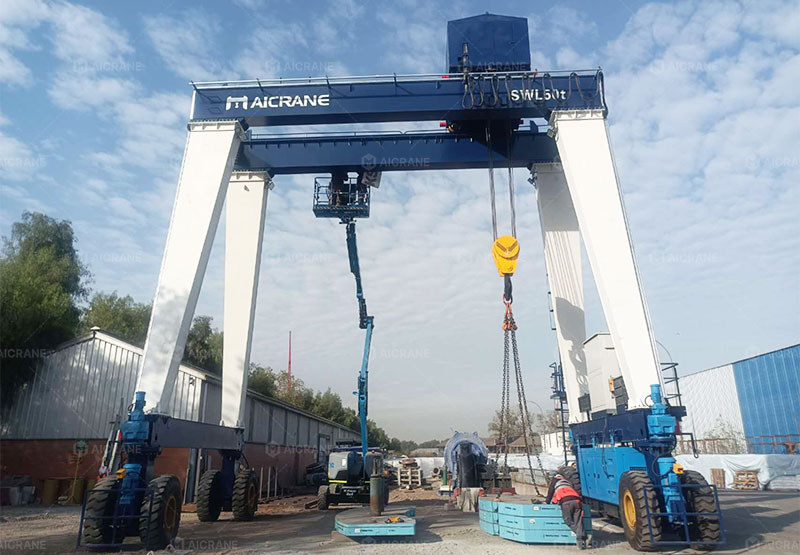
How A5 Affects a 50 Ton Gantry Crane
An A5 50 ton gantry crane is generally suitable when heavy lifting is required but the crane does not operate continuously at high utilization.
For example, consider a fabrication yard that needs to move a 30-50 ton steel structure several times per day. Between lifting operations, the crane may remain idle or perform relatively light positioning work.
In this situation, an A5 design may provide an appropriate balance between performance and investment.
Structural Requirements
The main girder, legs, trolley structure, connections, and other load-bearing components are designed for the expected number of working cycles and load spectrum.
The crane still needs sufficient structural strength for a 50 ton rated load, but its fatigue design does not necessarily need to match that of a crane operating continuously under demanding conditions.
Mechanical Components
Hoist components such as:
- Hoisting motor
- Gearbox
- Drum
- Wire rope
- Brakes
- Bearings
are selected according to the expected operating frequency.
Travel mechanisms for the trolley and entire overhead gantry crane are also sized according to the required travel cycles and operating speeds.
For a moderate-use application, choosing A7 equipment simply because the crane has a 50 ton capacity may result in unnecessary initial cost.
How A6 Affects a 50 Ton Gantry Crane
A6 represents a more intensive operating condition.
An A6 50 ton gantry crane may be appropriate for a production environment where the crane performs repeated lifting and positioning throughout the working day.
For example, a precast concrete plant may use a 50 ton gantry crane to move molds, concrete components, and other heavy elements repeatedly between production areas and storage yards.
Compared with an A5 crane, the A6 design needs to accommodate more frequent operation.
Increased Fatigue Considerations
Repeated loading causes fatigue stress in structural components.
Even if every individual lift is below the 50 ton rated capacity, thousands of repeated lifting cycles can have a significant effect on the service life of:
- Main girders
- End carriages
- Leg structures
- Welded connections
- Trolley frames
- Wheel assemblies
Therefore, an A6 crane requires a design that considers the expected number of working cycles over its service life.
Hoisting Equipment
The hoisting system also needs to withstand more frequent operation.
Depending on the project requirements, the crane may require:
- Higher hoisting motor duty
- More robust gearbox design
- Improved brake selection
- Appropriate cooling arrangements
- Higher-duty electrical components
- More suitable wire rope configuration
The objective is not simply to increase motor power. The entire lifting system needs to work reliably under the specified operating cycle.
How A7 Affects a 50 Ton Gantry Crane
A7 is intended for significantly more intensive service.
A 50 ton gantry crane in an A7 application may operate repeatedly during long production shifts, with frequent lifting, trolley travel, and gantry travel.
Examples can include certain heavy manufacturing facilities, steel production environments, and other applications where the heavy duty gantry crane is an integral part of a continuous material-handling process.
Higher Cycle Requirements
The major difference is the expected operating cycle.
An A7 crane may perform a large number of lifting and traveling movements over its service life. This increases fatigue exposure and mechanical wear.
Consequently, the design must pay greater attention to:
- Structural fatigue
- Wheel and rail interaction
- Hoist duty
- Brake wear
- Gearbox durability
- Motor thermal performance
- Electrical component life
- Maintenance accessibility
More Demanding Mechanical Design
The hoisting mechanism may need components specifically selected for intensive service.
For example, a 50 ton A7 crane could require a hoisting system capable of handling frequent starts, stops, acceleration, deceleration, and repeated heavy-load cycles.
The same principle applies to trolley and crane travel mechanisms.
If the crane travels hundreds of times per shift, wheel assemblies, gearboxes, motors, brakes, and drive systems experience significantly more operating cycles than those on an occasionally used crane.
Does A Higher Duty Class Mean a Better 50 Ton Gantry Crane?
Not necessarily.
This is one of the most important points for crane buyers.
An A7 crane is not automatically “better” than an A5 crane for every application. It is designed for a different operating condition.
Suppose a customer needs a 50 ton gantry crane to lift heavy machinery only three or four times per day. Specifying an A7 crane may increase equipment cost without providing a meaningful operational benefit.
Conversely, using an A5 crane in an application requiring continuous repetitive lifting could result in unsuitable component selection and reduced service life.
The correct question is therefore not:
“Which duty class is the strongest?”
Instead, ask:
“Which duty class matches the actual operating cycle of the crane?”
How Load Spectrum Changes the Duty Class
Operating frequency is only part of the calculation.
The load spectrum is also important.
Consider two 50 ton gantry cranes.
Crane A
- Rated capacity: 50 tons
- Most lifts: 10–20 tons
- Occasional lifts: 40–50 tons
- Moderate number of cycles
Crane B
- Rated capacity: 50 tons
- Most lifts: 40–50 tons
- High number of cycles
- Continuous production operation
Although both cranes have the same rated capacity, Crane B experiences a substantially more demanding load spectrum.
This can influence the required classification and the design of the hoisting and structural systems.
Therefore, when ordering a 50 ton gantry crane, buyers should provide the manufacturer with realistic information about the typical load distribution, not just the maximum load.
How Duty Class Affects Crane Price
Duty class can have a direct effect on the overall project cost.
Moving from A5 to A6 or A7 may require:
- Heavier structural components
- Higher-duty motors
- More robust gearboxes
- Different brakes
- Higher-duty electrical equipment
- More durable wheels and bearings
- Additional structural fatigue considerations
- More demanding manufacturing and testing
These changes can increase both material and manufacturing costs.
However, selecting a suitable higher duty class can also reduce long-term operating problems when the crane is genuinely used intensively.
For this reason, buyers should evaluate total lifecycle requirements, rather than comparing cranes only by purchase price.
Duty Class Also Affects Maintenance Requirements
Duty class should be considered when developing a maintenance program.
An A5 50 ton gantry crane operating occasionally may require fewer routine operating cycles than an A7 crane working multiple shifts.
For higher-duty cranes, maintenance planning should pay particular attention to:
- Wire rope condition
- Brake wear
- Gearbox oil
- Wheel flange and tread wear
- Bearings
- Structural welds
- Electrical connections
- Limit switches
- Emergency stop systems
- Hoist drums and sheaves
For an intensive-duty application, condition monitoring and scheduled inspections become increasingly important.
The maintenance interval should always follow the manufacturer’s recommendations, applicable regulations, and the actual operating conditions.
How to Choose Between A5, A6 and A7
Before selecting the duty class for a 50 ton gantry crane, collect several pieces of operational information.
1. Determine the Daily Operating Hours
How many hours will the crane operate each day?
A crane used for one or two hours is very different from one operating continuously across multiple shifts.
2. Estimate Lifting Cycles
Estimate how many complete lifting cycles the crane will perform per hour, day, month, and year.
Include both lifting and positioning movements.
3. Identify Typical Load Weights
Do not use the maximum 50 ton load as the only reference.
Determine how often the crane will lift:
- Less than 10 tons
- 10–25 tons
- 25–40 tons
- 40–50 tons
This provides a more realistic load spectrum.
4. Evaluate Travel Frequency
Trolley and gantry travel also contribute to crane utilization.
A crane that frequently moves across a large outdoor yard may experience considerably more mechanical cycles than a crane working within a small fixed area.
5. Consider Future Production Requirements
If production is expected to increase significantly, the crane should not be selected only according to today’s workload.
A higher duty classification may be justified when future operating hours or lifting cycles are expected to increase.
Final Considerations
For a 50 ton gantry crane, A5, A6, and A7 should be viewed as different design levels for different working conditions—not simply as three quality grades.
A5 is generally suitable for moderate utilization, A6 for heavier and more frequent operation, and A7 for intensive repetitive service. The correct selection depends on operating hours, lifting cycles, load spectrum, travel frequency, and the expected service life of the crane.
A properly specified duty class helps ensure that the structural system, hoisting mechanism, travel drives, brakes, electrical equipment, and other components are matched to the actual workload. Instead of choosing the highest classification automatically, buyers should provide the crane manufacturer with accurate operating data and have the duty class determined according to the applicable design standard.
For a custom 50 ton gantry crane, capacity is only the starting point. Duty class determines how that capacity is expected to be used over the crane’s working life.